 phone (01) 207 9881
  email info@lifeandbalance.ie
Stressing the Facts at Work26 Mar 2015
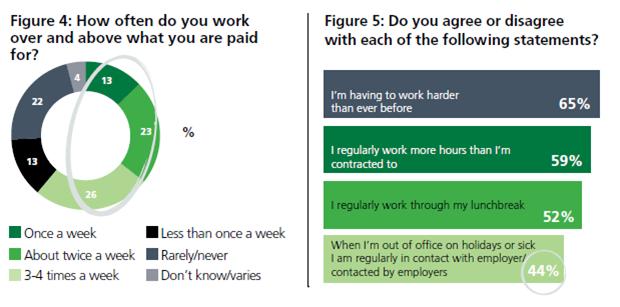
Stressing the Facts at Work Friday March 27th is the first National Workplace Wellbeing Day in Ireland. It is a day designed to raise awareness of health and wellbeing in the workplace and educate employers and employees about ways to optimise health. The working landscape is changing Ireland and all over the world. More and more of the workforce work in non-manual jobs that require their brain power rather than brawn. This means more of the health issues for staff now relate to psychological and psycho-physiological issues rather than traditional health and safety concerns such as manual handling, slips and falls or chemical exposure. In 2013 Aviva conducted an extensive research study of Irish employers and employees. This study was called the Aviva Workplace Health Index. This statistically representative study looked at work demands and health issues for the Irish workforce. The research found employees are under more pressure at work. Nearly two-thirds (62%) of employees worked over and above what they were paid for, at least once a week and a quarter (26%) worked over and above what they were paid for 3 to 4 times a week. 74% of employees agreed that the workplace had become increasingly stressful, while 72% felt a pressurised environment had become the norm.
When employees were asked what were their main health issues, stress and anxiety was number one with 55% stating this. As the figure below shows health issues related to stress then filled the next five most commonly mentioned health issues.
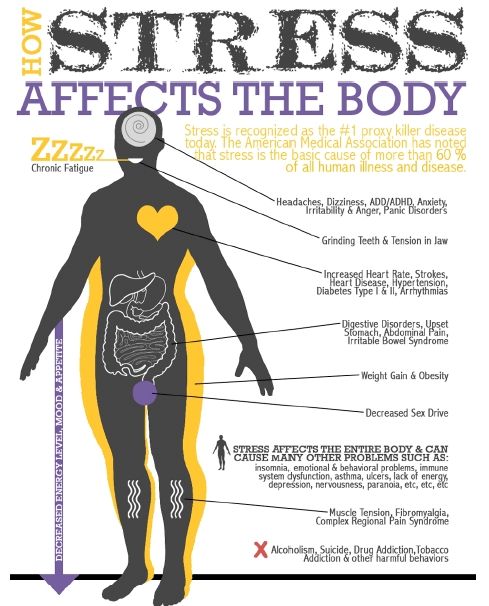
To understand why the majority of ill heath and sub-optimal performance relates to stress we need to consider what is the function of the stress response. Stress is designed as our bodies survival mechanism. It is only meant to be activated for short periods of time when there is a real treat. It is the Fight-or-Flight response to escape a danger or fight it to survive. The bodies energy is sent to the priority areas of the body to deal with the immediate threat. That is why you will experience tight muscles when you are stressed as muscle tension will help fight an attacker or run from them. You will also have an increased heart rate and blood pressure as these are needed for a Fight-or-Flight response. Your digestive system will slow down as you worry more about being eaten that what you have eaten. Many other changes also happen in your body. The opposite of the stress state is the growth, healing and repair state for the body controlled by the parasympathetic nervous system. You body can only operate in one state at a time. It is like forward and reverse gears in your car. You can go forward or reverse but not both directions at the same time. So if you are stuck in stress mode controlled by the sympathetic nervous system you will have increased muscle tension that will be causing your back to hurt, you will have lower immune system function meaning colds and flus will be more common, you will have trouble sleeping as you are on high alert mode and will wake up tired and you will have real trouble thinking properly. Interestingly for most people living and working in 2015 we very rarely encounter real threats to our life that would require a stress response to help us survive. However we do experience what our brain interprets as constant low grade threats. It is the phone ringing, being stuck in traffic and the light going red, a difficult customer, constant email interruption, an argument with your partner or mental overload from the constant stream of information we experience every day.
If you brain perceives anything to be a stressor the Fight-or-Flight response will be activated. Perception is very important. Do two people respond the same way to the same stimuli? Would a lion tamer have the same response to seeing a lion coming towards him compared to a member of the public that only has a cat to tame? So is the problem the stressor or how you respond to the stressor? In dealing with the stressors, one option is to try and change the environment around you to eliminate all possible stressors. Removing the lions might be easy, just stay away from the zoo but what about all the other potential stressors? Alternatively you can change the way you respond to a stressor. Which would be easier to achieve? Change your colleagues, your workload, your commute, your family responsibilities, your difficult clients etc. or change the way you respond to this environment? It is empowering to know that you can take control of your stress response rather than be controlled by it. What you need to do is retrain the way your nervous system responds to the environment. Hopefully one day you can learn to be the lion tamer and not be eaten by the lion. See how your nervous system is functioning right now with this evaluation.
|